
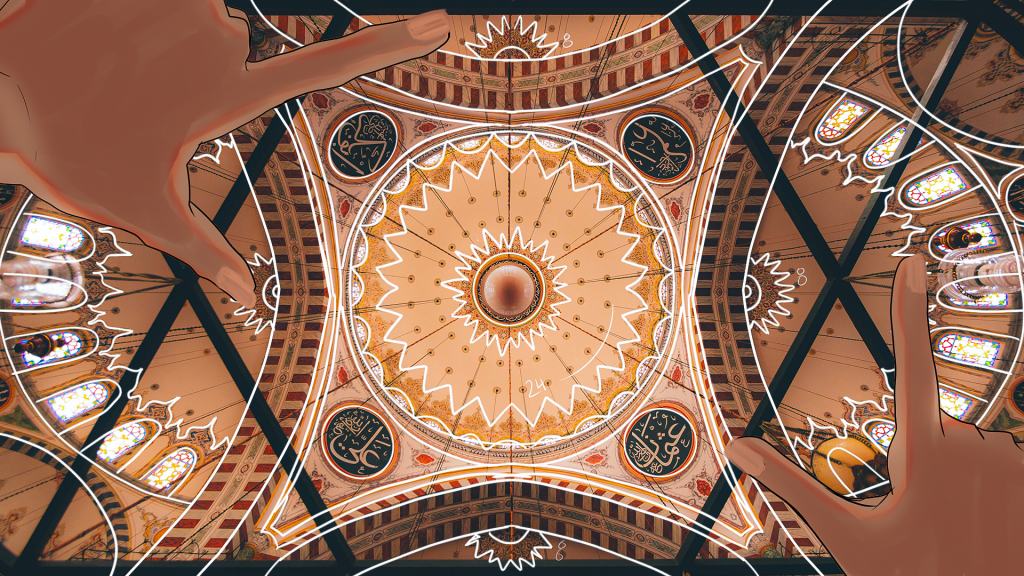
Enter any Muslim household regardless of nationality, and you are bound to come across some representation of Islamic art. Maybe Turkish biomorphic motifs inspired by flowers on a Turkish vase in a kitchen, Moorish tessellations on ceramics varied in geometric patterns and colors in a washroom, or South and Southeast Asian symmetrical wooden Jali carvings on furniture or window screens in a living room. There are also carefully beaded Syrian lamps, and metal carved Egyptian lanterns that may be hung up, reflecting interconnected psychedelic patterns through traveling light. Not to mention Kilim carpets from Persia and Central Asia on the ground, and of course, the intricate portraits of calligraphy that could be passed on generationally crafted on Nigerian and Mauritanian wooden slates or Chinese rice paper. And if you cannot find any such examples, you are bound to come across at least one prayer mat with a classical Qur’an decorated in an outer golden arabesque frame. All of which are representations of vastly diverse history and an amalgam of civilizational influences meshed into daily house usage.
Islamic art is an essential anthropological component of a Muslim’s life. However, it is often neglected, and its spiritual essence that inspired the mathematical calculations behind its patterns has been shrouded by the materialism of its making. The craft is often taught one-sidedly, focusing on the mathematical science of its techniques and formation without much exploration of the spiritual principles behind its inspiration.
Continue reading Fieldnoted.