Yusuf lost 30 family members overnight, killed in an Israeli bombardment of his neighbourhood in Gaza. “He’s not sure if his parents are alive. He won’t be able to meet you.”
This number — thirty — of Yusuf’s family, a Palestinian producer I networked with, clung to me. A man had just lost thirty family members in a single night. All of them disappeared in the blink of an eye. Are families even that big? Do I have thirty family members?
I raised my fingers and began to count. My parents, my siblings, my cat. My four aunts and their husbands. My cousins. I don’t have uncles, but I do have one grandmother left. Almost all my cousins are married now, so I added their partners. Some have kids — so more fingers folded. I counted the cats and dogs too. The realisation struck me: my family has over thirty members.
Suddenly, thirty wasn’t just a number. It was personal. It had shape and meaning. It was filled with faces, stories, memories and irreplaceable connections.
This disturbing ability to desensitise and normalise the abnormal — both within and beyond our global community — became chillingly apparent to me.
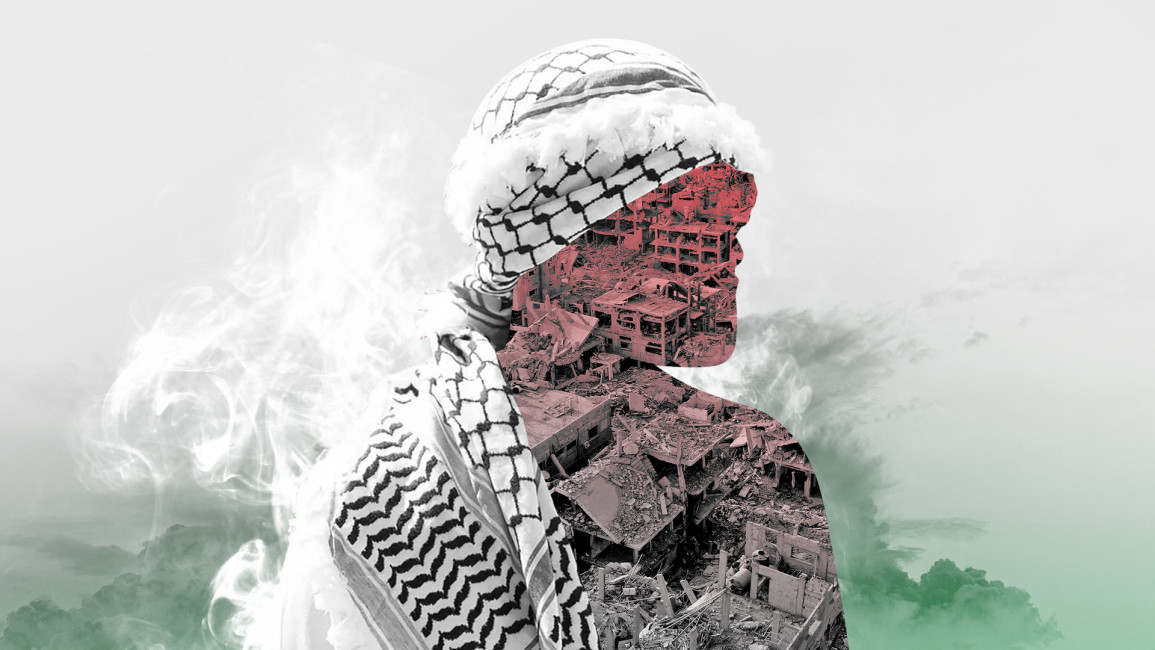
The never-ending imperial violence in the Middle East has not only devastated Palestine, but also shaped the Arab pysche, creating a dangerous sense of fatigue, helplessness, and silence.
We have to acknowledge this violence for what it creates – a cycle of historical transgenerational trauma that leaves us debilitated. But what if in our acknowledgement, we can finally explore the decolonial means to reclaim our humanisation?
Since the Nakba, Palestinians have faced continuous displacement, dispossession, and massacres. Each time, we are told this destruction is ‘unprecedented,’ yet for us Arab spectators, it is a cruel, ongoing cycle: bombardment, ceasefire, reconstruction — only for it all to be reduced to rubble again.
Displacement, war, autocracy, corruption — all — shape a non-ending cycle of traumatisation and re-traumatisation, compounded by the daily struggles of immigration, health, education, and economic instability in the global Arab diaspora. No wonder we have become fatigued — not just from war, but from compassion itself.
Google ‘compassion fatigue,’ and you’ll find results mostly related to caregivers, healthcare workers, social workers, activists, and journalists. But what about an entire diaspora, collateral damage to decades of continued colonialism?
Middle East Melancholia
To exhaust one’s compassion and will to resist is not solely the result of relentless exposure to oppressions, news and trauma — it is also the stripping away of agency. It is the inability to see the light at the end of the tunnel, leaving nothing but defeatism, inferiority, fear, and humiliation. With the continuous bombardment of systematic psychological, collective, and intellectual violence, we have reached an impasse with a heightened sense of incapability to change the status quo.
Palestinians remain the world’s longest-standing refugee population. Gaza alone housed 1.6 million Palestinian refugees in its 2.4 million population — a population now entirely re-displaced while facing the looming threat of ethnic cleansing via forced dispossession under the Abraham Accords.
In his latest book, Melancholy Act: Defeat and Cultural Critique in the Arab World, academic Nouri Gana explains that the chronic exposure to the collusion of despotism, neocolonialism, and Zionism in the Arab world leads to ‘subjective impasses’ that are morphed by sentiments of shame, guilt, and fear.
This is seen in the crushing depoliticisation of Arab universities that used to be a hub of political activism – now gone silent. The unusual silence of the Arab world has even left Francesca Albanese flabbergasted, as lulled acedia found root in sporadic protests across the region, in contrast to the consistent and loud rumbles of student demonstrations in the West.
These impasses are even reflected in our words, in the way we discuss our region over dinner and casual conversations.
When I reached for my phone, hoping to send Yusuf a message of sympathy, I was struck by how miserably I failed. Every text I typed felt hollow and meaningless, so I deleted them all.
For two days, I remained silent, unable to find words that carried the weight of his loss.
I felt ashamed. Helpless. There is nothing I can say to make the situation better.
A psychological reality that psychology PhD researcher Nadine Hosny and a group of mental health experts at the University of Lausanne, Switzerland, are paying attention to — advocating for the dire need for an intersectional analysis of mental health and cultural post-traumatic stress disorders (CPTSD) in the MENA region and the Arab diaspora.
As I turned to my family and friends for guidance on how to provide support and on what words to lighten the weight of this loss, I became aware of how disappointing, indifferent, and almost insultingly defeatist language we have normalised.
“There’s not much you can do, but pray.” one family member said.
A friend suggested, “Offer your regular condolences. Palestinians have been through this for generations. It’s a reality they know well.”
Another said, “Thank God it’s just 30. I heard of a Palestinian who lost 50” as if grief could be quantified like some macabre competition.
Their responses echoed a sentiment I grew up hearing far too often — a melancholia that pervades discussions of collective suffering in the Arab and Muslim world.
The plight of the Uyghurs in Xinjiang. The displaced Rohingya Muslims. The starving children of Sudan and Yemen. The wars in Afghanistan and Iraq. The oppression in Kashmir. The growing Islamophobia permeates Western borders. Each tragedy met with the same refrain: conditioned, learnt helplessness.
How to Decolonise Healing
Dr. Samah Jabr, Head of the Mental Health Unit at the Palestinian Ministry of Health, explains that learned helplessness is a state in which individuals, overwhelmed by prolonged powerlessness, abandon the hope of changing an unjust reality.
But what if we decide to utilise our generational cycle of traumatisation and choose not to be immobilised by it? How would the re-humanisation of Arabs empower Palestinians and what would it look like?
Decolonial Martiniquais thinker and Frantz Fanon’s mentor, Aimé Césaire, long emphasised the importance of decolonisation through re-humanisation. This is not just a political revolution, but a psychologically and culturally necessary process in reclaiming selfhood.
Decolonial healing is no passive feat — it begins by transforming our melancholic vocabulary into roars.
It means rejecting the language that legitimises our oppression and refusing to refer to the inexplicably brutal deaths of our fellow Palestinians with indifference and apathy. It viscerally acknowledges that this violence is not normal and a state we should not get used to.
Yusuf’s family is just a drop of millions in the sea of Palestinian suffering, but what do we as fellow Arabs do to elevate that suffering? As we found out, the ceasefire is nothing but a breather for the Gazans. In time, the disposition, land theft, and apartheid policies will escalate. Will we continue to wallow in our victimhood, or will we fuel our collective resistance and revival?
Yusuf and I eventually reconnected. There was an unspoken understanding between us. We did not discuss his loss. Instead, we spoke with determination about future projects. Together, we decided to reclaim our agency and honour our ancestral historical trauma through our work.
So, what do you tell a Palestinian who lost thirty family members in one night?
I may never find the perfect words, but silence, I have come to realise, is the cruellest response of all.
*Yusuf is a pseudonym used to protect the person’s identity.
Image Credit: Benjamin Ashraf
Original Publication: 03/25 @TheNewArab


 Fieldnoted.